
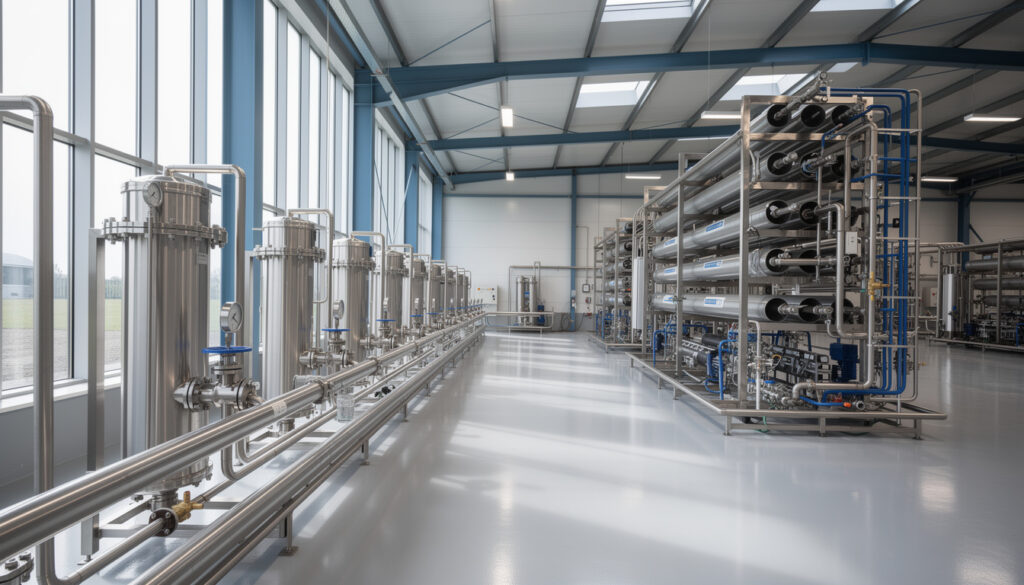
What are industrial water treatment solutions and why do sustainable operations need them?
Industrial Water Treatment Solutions for Sustainable Operations cover two directions at once: cleaning up water before it enters a process, and treating what comes out the other end before it leaves the site. Process water treatment conditions raw intake so it won't corrode piping, foul heat exchangers, or wreck sensitive production equipment. On the discharge side, industrial wastewater treatment strips out contaminants before water is reused, sent to a municipal system, or released to a receiving body.
The real expense of water rarely shows up as a single line item. Acquisition cost is just the start, heating that water, dosing it with chemicals, pumping it through the plant, and paying discharge fees all stack on top. Facilities that only track the water bill miss the bigger picture, which is why freshwater intake reduction has become a budget conversation as much as an environmental one.
Understanding the scope of industrial water streams
Raw influent conditioning, closed-loop circulation, process rinsing, and final wastewater treatment are distinct jobs, even though they often get lumped together as "the water system." A food plant might need near-drinking-water quality for rinsing but tolerate rougher water for washdown. A semiconductor fab, on the other end of the spectrum, needs ultrapure process water with almost nothing dissolved in it.
The hidden costs of unoptimized water systems
Scaling inside heat exchangers cuts thermal efficiency long before anyone notices a drop in output, the boiler or chiller just quietly works harder. Membrane fouling, chemical dosing nobody is watching, and unplanned downtime from a fouled system all add up. According to the USGS industrial water use overview, industrial withdrawals remain a substantial share of total water use, which is one reason regulators and insurers now pay closer attention to how plants manage this cost.
Designing a treatment train: from raw water to polished discharge
Before anyone picks equipment, a facility needs a water analysis, a sense of peak flow rates, and a record of contamination spikes tied to specific production events. Skipping this step is how plants end up with undersized pretreatment and oversized polishing stages that fight each other.
A treatment train is simply a sequence of stages, each removing a narrower category of contaminant, coarse solids first, then dissolved organics, then finally dissolved ions. Getting the water balance right across that sequence, rather than treating each stage in isolation, is what keeps downstream membranes from getting overwhelmed. Pilot studies matter here: running a scaled-down version of the train on actual site water catches problems that lab-grade synthetic water never reveals. The EPA Lean water toolkit frames this kind of metering and sub-metering discipline as a core efficiency lever, not an afterthought.
Essential inputs for facility water mapping
Total dissolved solids, chemical oxygen demand, turbidity, oil content, and heavy metals are the baseline parameters worth testing before any design decision. Flow profiles matter just as much, a plant with sudden batch dumps needs different buffer tank sizing than one with a steady 40 cubic meters per hour draw.
Building blocks of a modern treatment plant
Mechanical screens, equalization tanks, and oil-water separators handle the rough pretreatment work. Coagulation, flocculation, and dissolved air flotation take care of primary clarification. From there, ultrafiltration and reverse osmosis handle solids separation and dissolved contaminants, with a polishing or ion-removal stage at the end for anything that still needs cleaning up.
| Treatment stage | Target contaminant | Typical technology |
|---|---|---|
| Pretreatment | Coarse solids, oil, grit | Screens, oil-water separators |
| Primary clarification | Suspended solids, colloids | Coagulation, flocculation, DAF |
| Membrane filtration | Fine particulates, bacteria | Ultrafiltration (UF) |
| Desalination/polishing | Dissolved salts, ions | Reverse osmosis, ion exchange |
Boiler and cooling tower systems: where water waste hides
Scaling, corrosion, and biofouling are the three threats that quietly drain money from open and closed loops alike. Plants that run cooling towers at low cycles of concentration end up pulling far more makeup water than necessary, while also burning through more chemical treatment per liter of water actually used. Pushing cycles higher, within the limits the water chemistry allows, cuts both problems at once, but only if it's backed by real-time monitoring rather than a fixed schedule.
Managing boiler feedwater quality
Hardness removal and dealkalization keep calcium and magnesium from baking onto boiler tubes, which is the single biggest driver of internal scaling and heat loss. Dissolved oxygen is the other enemy, mechanical deaeration paired with chemical oxygen scavengers keeps pipe corrosion from eating away at the feedwater lines.
Controlling cooling loop efficiency and biological risks
Cooling towers are warm, wet, and full of surface area, which makes them a natural home for microbial growth, including the bacteria behind Legionella outbreaks. Biocide dosing tied to actual biological activity, rather than a calendar, keeps this risk down. Blowdown optimization works the same way: adjusting drain rates against real-time conductivity readings wastes far less water than dumping on a fixed timer.
Water reuse and zero liquid discharge compared
Internal industrial water reuse and zero liquid discharge sit on the same spectrum but solve different problems. Reuse loops recycle rinse water or route treated wastewater back into cooling tower makeup, a modest, low-risk step that shrinks freshwater intake without touching the discharge side. ZLD goes further, converting essentially all liquid waste into purified water and dry solids, with no liquid discharge stream left at all. Minimal liquid discharge (MLD) sits between the two, concentrating waste streams heavily without chasing the last drop.
Regulatory framing differs too. Internal reuse usually stays inside a plant's existing operational permit, while ZLD and cross-process reuse projects often draw more scrutiny around brine management and residuals handling. The EPA industrial reuse resources page is a useful starting point for understanding how these regulatory expectations are typically structured.
Practical internal recycling loops
Facility washdown, cooling tower makeup, and secondary rinsing are the low-risk, high-volume targets most plants tackle first. Each end use has its own water quality bar, washdown tolerates more than rinse water feeding back into a production line, so recycling loops need to be matched carefully to protect downstream equipment.
Thermal and membrane ZLD process steps
High-recovery reverse osmosis and electrodialysis handle the first round of brine concentration, pulling out as much clean water as membranes can manage. What's left goes to thermal evaporators and crystallizers, which drive off the remaining moisture and leave behind a dry salt cake for disposal or, in some cases, resale as a byproduct.
Metrics that separate resilient plants from failing ones
Freshwater intensity per unit produced, reuse percentage, specific energy consumption per cubic meter treated, and chemical cost trends are the core numbers worth tracking monthly. Normalized membrane flux and differential pressure are the early-warning signals, a slow drift in either one usually means scaling or fouling is building before anyone notices a drop in output. Plants that watch these figures catch problems weeks before a costly shutdown, and that's really the difference between sustainable water management on paper and operational resilience in practice.
All information about the business is available at the following link: aquaphorpro.com.
Core KPIs for sustainable water monitoring
Tracking liters per unit produced alongside reuse percentage gives a clear read on how to reduce wastewater discharge in manufacturing without guessing. Specific energy consumption per cubic meter treated ties water performance directly to the utility bill, which tends to get management attention fast.
A practical 90-day implementation roadmap
The first 30 days go into water balance audits, sub-meter installation, and sampling at key discharge points. Days 31 to 60 focus on the highest-volume internal reuse opportunities, dosing optimization, and small pilot runs of candidate technologies. The final stretch, days 61 to 90, is about locking in standard operating procedures, calibrating online instruments, and training staff to actually read the KPI dashboards instead of ignoring them.
Frequently asked questions regarding industrial water treatment
How can oil and emulsified fats be removed from process wastewater?
Gravity separation handles free oil first, but emulsified fats usually need dissolved air flotation with a chemical demulsifier to break the emulsion apart. A ceramic membrane polishing stage often follows for facilities that need very low residual oil before discharge or reuse.
What causes reverse osmosis membranes to foul quickly in reuse projects?
Unmanaged biofouling is the usual culprit, often paired with weak particulate filtration in pretreatment. Organic fouling and exceeding the solubility limits of silica or calcium are the other common causes, and both point back to a pretreatment stage that wasn't sized for the actual feed water.
How much freshwater intake can a typical manufacturing plant reduce?
Comprehensive reuse projects have cut freshwater demand anywhere from 30 percent to over 80 percent, depending on the industry and how strict the end-use water quality needs to be. Plants with flexible internal reuse loops, such as cooling makeup, tend to land at the higher end.
Why do industrial water treatment programs fail in practice?
Inadequate operator training and a lack of continuous online monitoring are the most common causes. Poor pretreatment selection and ignoring seasonal changes in raw water quality also show up repeatedly when a program that worked fine on paper starts breaking down on the plant floor.
About the Business
AQUAPHOR Professional is a manufacturer of advanced commercial and industrial water purification systems. The company develops engineered solutions for diverse applications, including industrial manufacturing, commercial facilities, agriculture, HoReCa, healthcare, and municipal settings. AQUAPHOR Professional specializes in membrane filtration, reverse osmosis, ultrafiltration, and custom-designed water treatment trains built for operational reliability, energy efficiency, and low life-cycle costs.